The history of Tanzania
Two countries became one. Tanganyika, on the mainland, and the islands of Zanzibar each won independence from Britain, and in 1964 they joined as the United Republic of Tanzania. Behind that lie the oldest traces of our own species, a thousand years of Swahili trade, and a colonial century fought at every step.
- Tanganyika independent
- 9 December 1961
- Zanzibar independent
- 10 December 1963
- The Union
- 26 April 1964
- Named Tanzania
- 29 October 1964
Olduvai Gorge and Laetoli hold one of the longest records of human evolution anywhere: footprints of people walking upright, and fossils from Zinjanthropus to Homo sapiens. The rock paintings of Kondoa are far younger, and still in use.
Where to see itNgorongoroKondoa
Hunter-gatherers, then herders from the north about 3,000 years ago, then Bantu-speaking farmers who brought iron: the reason Tanzania speaks 126 languages from four unrelated families.
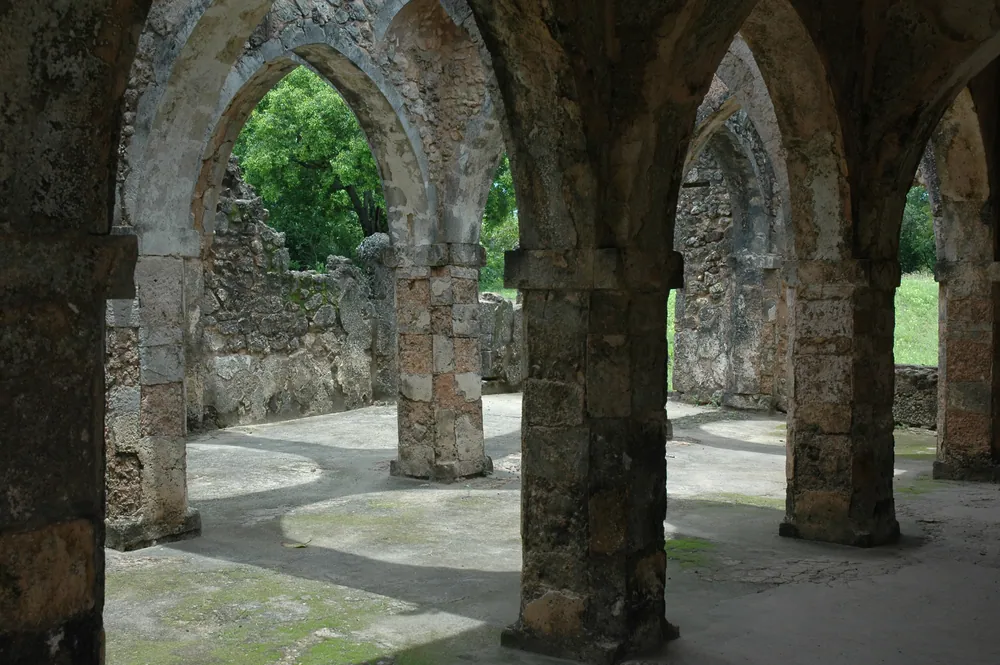
Stone towns of trade on the Indian Ocean, from Kilwa to Zanzibar, where Swahili became the language of the coast. Kilwa at its height minted its own coins.
Where to see itKilwaBagamoyoMafiaStone Town
- 041498 – 1840s
The Portuguese and the Omanis
The Portuguese came in 1498 and took the coast by force; the Omanis drove them out and made Zanzibar the capital of a trading empire.
Where to see itKilwaStone Town
- 061885 – 1919
German East Africa
German rule, first through a company and then as a colony, fought at every step — by Abushiri on the coast, by Mkwawa's Hehe, and in the Maji Maji war of 1905–07.
Where to see itSongeaRuvumaIringaBagamoyoDar es Salaam
- 071914 – 1918
The First World War in East Africa
Four years of war across the colony, from the Battle of Tanga in 1914 to the German surrender in 1918, and a German warship on Lake Tanganyika that survives as the MV Liemba.
- 081919 – 1961
British Tanganyika
A League of Nations mandate from 20 July 1922, later a United Nations trust territory. TANU, founded in 1954 under Julius Nyerere, led it to independence.
Where to see itIringaMtwaraKilimanjaro
The sultans, the clove plantations and the slave market; the British protectorate; independence on 10 December 1963 and the revolution of 12 January 1964.
Where to see itStone TownUngujaPemba
- 101961 – 1985
Independence and the Nyerere years
Independence, the republic, the Union with Zanzibar, the Arusha Declaration and ujamaa, one-party rule and the move of the capital to Dodoma.
Where to see itDodomaMara (Butiama)Arusha
- 111985 – today
The multi-party era
Political parties allowed again from 1992, the first multi-party elections in 1995, and the presidents since.
Key dates
Last reviewed 2026-09-28
Editorial — fact-check complete
Checked against
- History of TanzaniaEncyclopaedia Britannica
- Tanzania — country constitutional profileConstitutionNet (International IDEA)
- Tanganyika Republic Act 1962legislation.gov.uk
- Zanzibar (Independence) — House of Commons, 5 December 1963Hansard, UK Parliament
- The United Republic of Tanganyika and Zanzibar is renamed United Republic of TanzaniaSouth African History Online
- Anglo-German Treaty [Heligoland–Zanzibar Treaty], 1 July 1890German History in Documents and Images
- British Mandate for East AfricaUN Archives Geneva
Period summaries draw on the place pages linked under each, where every fact is sourced.