The Great Migration, month by month
Where the wildebeest herds are through the year, why they move, how many there really are, and where in Tanzania to watch each stage, from calving on the southern plains to the Mara River crossings.
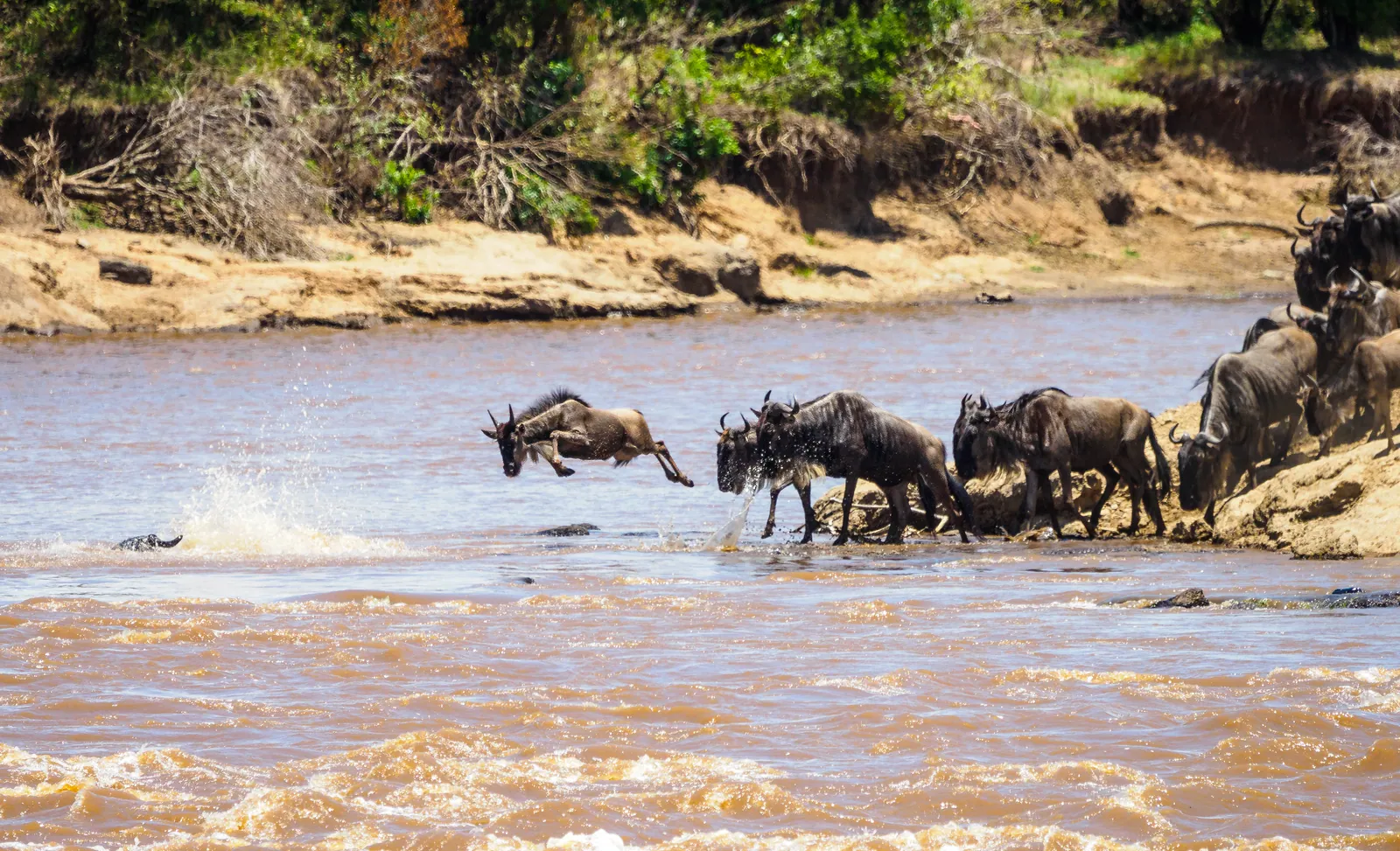
A wildebeest leaping into the Mara River in the northern Serengeti. The crossings run from about July.
- Where
- Serengeti–Mara ecosystem, Tanzania and Kenya
- Route
- A clockwise loop of roughly 800 km a year
- Calving
- Southern plains, peaking in February
- River crossings
- Northern Serengeti, from about July
- Drives it
- Rain, and the grass that follows it
What the migration is
The Great Migration is the year-round movement of wildebeest, with zebra and gazelle, around the Serengeti–Mara ecosystem. It has no start or finish. The herds loop clockwise from the short-grass plains of the southern Serengeti and the Ngorongoro Conservation Area, north-west through the park, north into Kenya's Maasai Mara, and back south again: a circuit of roughly 800 kilometres.
Most of that loop is in Tanzania. Kenya holds the northern end, which the herds usually reach in the dry season, from around late July or August.
Where the herds are, month by month
The table below is the usual pattern. The herds follow the rain, and the rain does not keep a calendar, so a wet or dry year can move everything by several weeks. Operators and camps track the herds day to day; treat any month-by-month guide, this one included, as a starting point, not a promise.
| Months | Where the herds usually are | What is happening |
|---|---|---|
| December – March | Southern Serengeti and the Ndutu plains | Grazing the short grass of the wet season. Calving peaks in February. |
| April – May | Moving north-west through the central Serengeti | The long rains. The herds spread out and begin to move. |
| May – June | Western corridor, towards the Grumeti River | Herds gather in the west as the plains dry, before heading north. |
| July – October | Northern Serengeti and Kenya's Maasai Mara | The Mara River crossings. Herds move back and forth across the river. |
| November | Heading south through the eastern Serengeti | The short rains begin, and the herds return to the southern plains. |
Why they move
The simple answer is grass. The herds are grazers on a scale the land can't carry for long in one place, and they follow the rains to wherever the grass is fresh.
The fuller answer is in the soil. The treeless short-grass plains of the south-eastern Serengeti lie on volcanic ash blown from the neighbouring volcanic highlands, and research published in Ecology in 2025 identifies these as the most phosphorus-rich soils in the park. Phosphorus and calcium are exactly what a lactating wildebeest needs, which is why the herds return to the southern plains to give birth there during the wet season.
When the rains stop, those plains dry out quickly. The herds move towards the permanent water and taller grass of the west and north, and come back when the rain returns.
The calving season
In February the herds are on the southern plains and give birth in a remarkably short window. Around half a million calves are born within two to three weeks. Biologists see the timing as a defence: when so many calves arrive at once, predators can take only a fraction of them before the rest are strong enough to keep up with the herd.
It is also when the predators are most active. Lion, cheetah and hyena concentrate on the plains, and this is one of the best times of year to see a hunt.
The centre of it is the Ndutu area. Lake Ndutu itself lies just inside the Ngorongoro Conservation Area, on the Serengeti boundary, so conservation-area rules and fees apply there rather than national-park ones.
The river crossings
The crossings people picture are on the Mara River in the northern Serengeti, from about July. Herds bunch on the bank, sometimes for hours or days, then pour down the cut banks into water where crocodiles wait. They cross back and forth through the dry season, so there is no single crossing to catch.
On their way north the herds also cross the Grumeti River in the western corridor, a smaller river than the Mara.
A crossing cannot be scheduled. Seeing one well mostly means being in the north for several days and being patient on the day.
A good guide keeps well back from the crossing point. Vehicles crowding the bank can turn a herd away from the river.
How many wildebeest are there?
The figure you will see everywhere is about 1.3 million wildebeest. It comes from aerial surveys, the method used since the 1970s; the most recent survey by the Tanzania Wildlife Research Institute (TAWIRI), in 2023, again estimated roughly 1.3 million.
In 2025 a team of researchers from Princeton, Oxford, Twente and other institutions published a different count in PNAS Nexus. Using AI to detect animals in high-resolution satellite images from August 2022 and 2023, they counted fewer than 600,000, about half the accepted figure.
The authors say the two methods should be seen as complementary rather than contradictory. Their images covered part of the range at one time of year, some wildebeest may have been outside the area surveyed, and satellite images can't yet tell a wildebeest from a zebra or eland beside it. If the lower number is right, it could mean the herds have declined, or that past counts were too high. Nobody knows yet, and the researchers are calling for aerial and satellite surveys to be flown together to settle it.
Whichever figure is right, it remains one of the great wildlife spectacles on earth.
- When is the best time to see the Great Migration in Tanzania?
- It depends on what you want to see. February is best for calving on the southern plains around Ndutu; July to October for the Mara River crossings in the northern Serengeti. The herds are somewhere in the ecosystem all year.
- Where is the migration in June?
- Usually in the western corridor of the Serengeti, around the Grumeti River, beginning to move north.
- Is the migration in Tanzania or Kenya?
- Both, but mostly Tanzania. The herds spend most of the year in the Serengeti and the Ngorongoro Conservation Area, and are in Kenya's Maasai Mara for part of the dry season, roughly August to October.
- How many wildebeest are in the migration?
- The long-standing aerial estimate, repeated by TAWIRI in 2023, is about 1.3 million. A 2025 satellite study counted fewer than 600,000; the difference is unresolved.
Last reviewed 2026-09-19
Editorial — fact-check complete
Checked against
- AI-based satellite survey offers independent assessment of migratory wildebeest numbers in the SerengetiPNAS Nexus, 2025
- Unraveling the drivers of forage quality variation in the SerengetiEcology, 2025
- Wildebeest migration: AI counts indicate low numbersAfrica Geographic
- Serengeti: the Great MigrationWikipedia