Kondoa
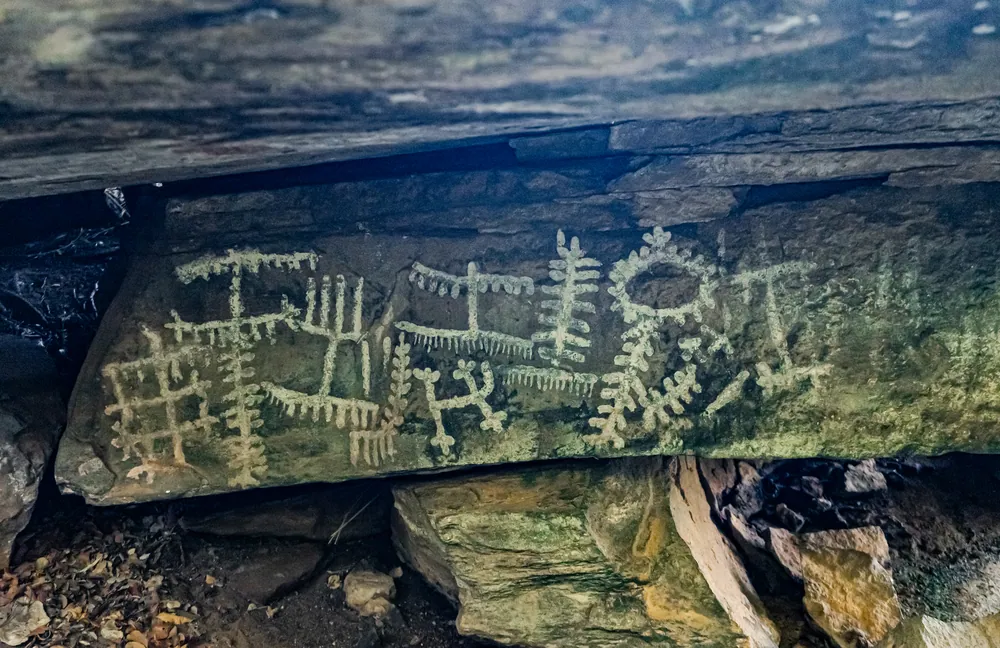
Painted rock shelters on the Masai escarpment, made over at least two thousand years and still used for rainmaking and healing: the Kondoa Rock-Art Sites, a UNESCO World Heritage Site since 2006.
Paintings on a rock shelter at Kondoa. The shelters sit in wooded hills on the eastern slopes of the Masai escarpment.
- Region
- Kondoa District, Dodoma Region
- Status
- UNESCO World Heritage Site, inscribed 2006
- Painted shelters
- An estimated 150 to 450
- Age
- Painted over at least two thousand years
- Main site
- Kolo, about 20 km north of Kondoa town
Two thousand years of painting on one escarpment
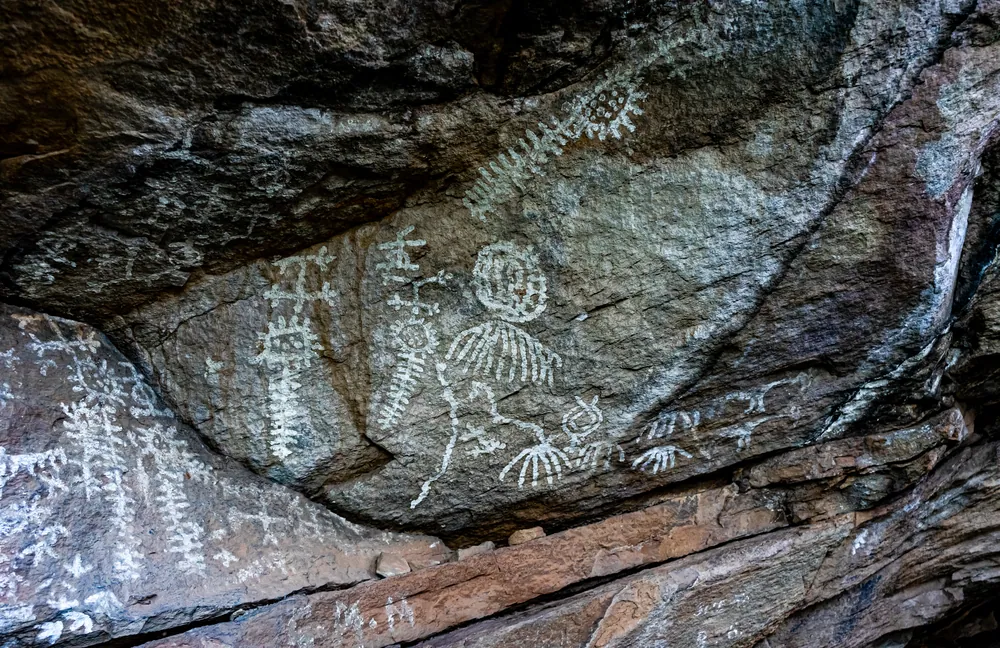
North of Dodoma, the Masai escarpment runs along the western edge of the Great Rift Valley. Its eastern slopes are broken by rift faults into overhanging slabs of rock, and for at least two thousand years people have painted on them. UNESCO estimates there are between 150 and 450 decorated shelters, caves and cliff faces. Nobody knows the exact number, because some areas have never been surveyed.
The paintings come in layers. The oldest are fine-line figures in dark reddish-brown: elongated people with elaborate headdresses, carrying bows, alongside elephant, giraffe, eland, rhino and antelope. They are attributed to the hunter-gatherer ancestors of the Sandawe, one of the first peoples of Kondoa. Later come paintings by herding peoples, and the white paintings of farming communities, which often show cattle. UNESCO lists the sites because that sequence records the change from hunting and gathering to farming and herding.
No painting has been scientifically dated. Estimates for the oldest range from about three thousand years to ten thousand or more, and the weathering makes the earliest dates impossible to prove for now. The ground beneath the shelters is older still. At the Kisese II rock shelter, excavated by the Leakeys from 1935, ostrich-eggshell beads have been dated to more than 40,000 years ago.
Missionaries first reported the paintings to Europeans in 1908. Mary and Louis Leakey studied them through the 1930s and 1950s and documented more than 1,600 painted images at 186 sites north of Kondoa. Many of the paintings they recorded in the early 1950s have since faded badly or disappeared.
Kondoa town has a later history too. In the First World War, South African troops under Jacob van Deventer took the town in April 1916, and Lettow-Vorbeck's German force attacked them there from 7 to 10 May 1916, one of the larger actions of the East African campaign.
Protected since 1949, and still fragile
How the sites are protected
- 1949
- Twelve sites made National Monuments
- 1964
- Antiquities Act, amended 1979
- 1981
- Sites re-gazetted, seven more added
- 2004
- Declared a Conservation Area
- 2006
- Inscribed as a World Heritage Site
The Kondoa paintings have been protected by law for a long time. Twelve sites were made National Monuments in 1949, and the whole area was declared a Conservation Area in 2004, two years before UNESCO inscribed it. The sites are managed by the Antiquities Division of the Ministry of Natural Resources and Tourism.
The paintings have never been restored or retouched, which is part of what makes them valuable, and part of what makes them vulnerable. Dust from the ground and water seeping down the rock are both slowly wearing them away. UNESCO also points to farming, cattle grazing and the cutting of wood around the sites. The woodland matters: it shades the rock and holds the soil, and clearing it for building material or fuel could badly damage the paintings.
Many sites were dug illegally before inscription, which destroyed the archaeological layers beneath them. In 1983 Mary Leakey warned that without serious conservation the paintings would be gone by 2020. Many survive, but her warning is why the rules for visitors are strict.
Sites that are still in use
What sets Kondoa apart from most rock-art sites is that it is not only in the past. UNESCO lists it partly for this: some shelters are still used by local communities for rainmaking, divination, healing and initiation. The places where hunter-gatherers once painted, perhaps to influence the weather, are used by farming villages today for their own rain ceremonies.
The most powerful of them, according to oral tradition, is Mongomi wa Kolo, the main shelter at Kolo. A hollow under a huge boulder a few metres to its south is still used by diviners, healers and rainmakers. Researchers have linked some of the paintings to the Sandawe practice of simbó, in which dancers are believed to take on the power of an animal, often the lion.
Living use and conservation do not always sit easily together. In some rain ceremonies animal fat and beer are thrown over the paintings. UNESCO notes this as a possible recent version of older practices, and a problem the site's managers have to balance against the communities' rights to their own sacred places.
The district is home to the Rangi (Warangi), who speak a Bantu language, Kirangi, and are mostly Muslim, together with the Sandawe, Alagwa and Datooga. The Sandawe tradition of painting did not end in the distant past. About 1970 a researcher recorded Sandawe men still making rock paintings, and UNESCO cites a recent painting by a Sandawe-speaking man as evidence of a tradition that may run back thousands of years.
2006
Year inscribed
Kondoa Rock-Art Sites
Painted rock shelters made over at least two thousand years by hunter-gatherer and later farming and herding peoples. Some are still used by local communities for rainmaking, divining and healing, which ties the paintings to living tradition.
- Type
- Cultural site
- UNESCO criteria
- (iii)(vi)
- Listed area
- 2,336 km²
- In danger
- Never listed
From the UNESCO listing
- UNESCO estimates 150 to 450 decorated shelters, caves and cliff faces on the eastern slopes of the Masai escarpment.
- The paintings are the northernmost examples of a hunter-gatherer art tradition shared with southern and central Africa.
- Their sequence records the change from hunting and gathering to farming and herding.
Informational — none of this is ticketed by us
World Heritage
Mongomi wa Kolo (Kolo 1)
The main shelter, reached by a winding path at the end of a dirt road. Fine-line red figures, some faded, at a site still used for ritual.
World Heritage
Kolo 2 and Kolo 3
The shelters south and north of the main site: human and animal figures at Kolo 2, and geometric designs as well at Kolo 3.
Visitor centre
The Antiquities office at Kolo
On the main road at Kolo. Buy your permit and hire your guide here, and see the small museum on the Irangi people first.
Archaeological site
Kisese II rock shelter
Excavated from 1935. Its Stone Age layers include ostrich-eggshell beads more than 40,000 years old.
Landscape
The Masai escarpment
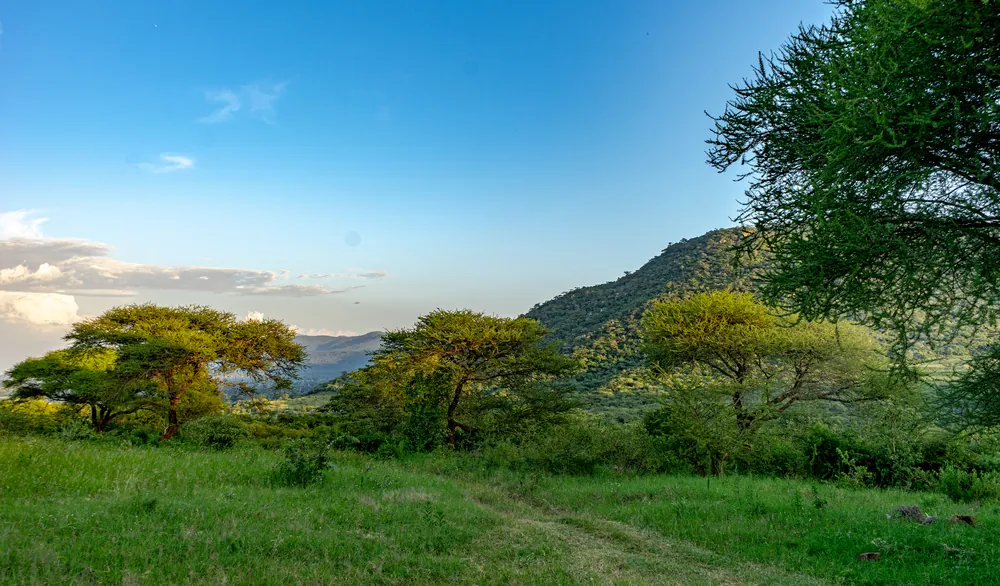
Wooded, broken hills on the edge of the Rift. The climbs to the shelters are steep, and the views from the top are the reward.
Town
Kondoa town
The district centre, and the scene of a German attack on South African forces in May 1916.
Before you go
- Getting there
- Kolo is on the T5 highway between Dodoma and Babati, about 20 km north of Kondoa town and roughly three hours by road from Dodoma. The shelters are about 9 km east of the highway.
- Permit and guide
- Buy a day permit at the Antiquities office in Kolo and go with a guide. Many shelters are unmarked. Fees are set by government, so check the current rate at the office.
- Transport
- Bring your own vehicle. The track from the highway to the sites is rough, and a 4x4 is best, especially in the rains.
- Walking
- The main Kolo shelters need a steep climb. Wear proper shoes and carry water; a short visit to Kolo 1 to 3 takes a couple of hours.
- Respect
- Never touch the paintings or splash water on them to bring out the colour. Some shelters are sacred places, so follow your guide on where to go and what to photograph.
- When to come
- June to October is dry. The rains, roughly December to April, make the tracks harder going.
Last reviewed 2026-09-19
Editorial — fact-check complete
Checked against
- Kondoa Rock-Art Sites — World Heritage ListUNESCO
- Kolo, Tanzania — the Kondoa rock artThe British Museum, African Rock Art
- Tanzania — rock art research, styles and chronologiesThe British Museum, African Rock Art
- Kondoa Rock-Art Sites — Kisese II, research historyWikipedia
- Kondoa District — peoples and the T5 highwayWikipedia
- Rangi peopleWikipedia
- Battle of Kondoa Irangi (1916)Wikipedia
- How to visit the Kondoa Irangi rock paintingsCycloscope (visitor report)