Agriculture in Tanzania
Two in every three working Tanzanians farm. What they grow and where: the food crops that feed the country with a surplus to spare, the export crops that each belong to a region, the livestock, and the government's plan to nearly double the pace of growth by 2030.
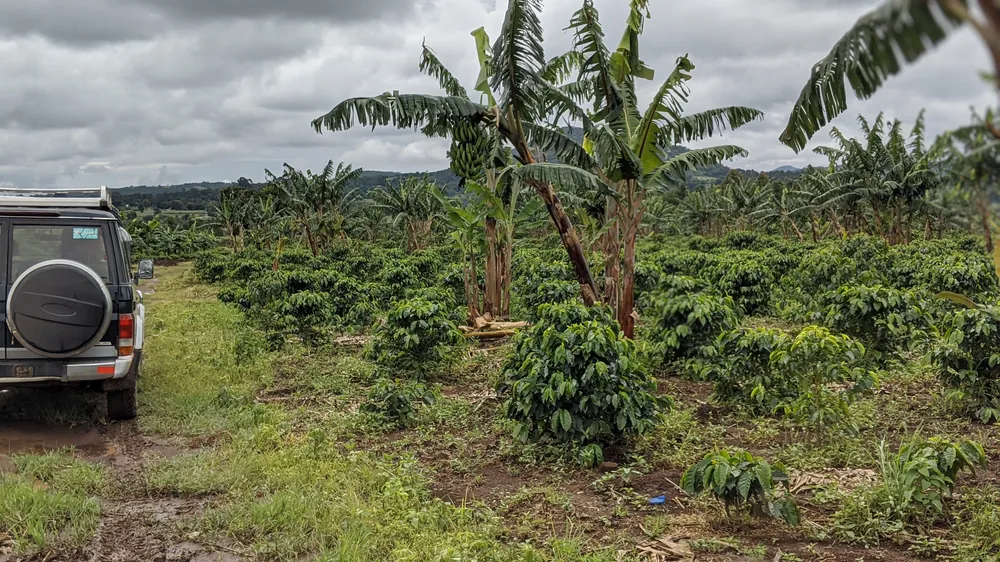
Coffee grown under bananas on a smallholding in Songwe Region.
- Jobs
- About 65% of employment in 2025 (World Bank, ILO estimate)
- Share of GDP
- 22.9% in 2025, with forestry and fishing (World Bank)
- Farming households
- 7.8 million of 12.0 million in 2019/20 (NBS census)
- Food
- 130% self-sufficient in 2024/25 (Ministry of Agriculture)
- Top crop export
- Tobacco, USD 600 million in the year to April 2026 (Bank of Tanzania)
The country's biggest employer
Mining earns Tanzania the most money abroad; farming employs the most people at home. About 65 per cent of working Tanzanians were employed in agriculture in 2025, on the World Bank's modelled estimate, and agriculture, forestry and fishing together produced 22.9 per cent of GDP. The share of GDP has drifted down, from 25.3 per cent in 2020, as other sectors grew faster, but no other activity touches as many households.
The 2019/20 National Sample Census of Agriculture counted 7.8 million farming households out of 12.0 million in the country, or 65.3 per cent. Almost all of them are smallholders. Two-thirds grow crops only; a third keep livestock as well.
The country feeds itself, and more. In April 2026 the Minister of Agriculture, Daniel Chongolo, told Parliament that food-crop production in the 2024/25 season reached 23.8 million tonnes against a national requirement of 18.3 million, a food self-sufficiency ratio of 130 per cent. The surplus is sold abroad: maize and rice earned USD 160 million in the year to April 2026.
What Tanzania eats
Most farming is for food, and most of it depends on the rains. Maize is the staple across most of the mainland, eaten as ugali. Rice comes from the river valleys and irrigated schemes, the Kilombero valley in Morogoro among them. Cassava, sorghum and millet carry the drier country, bananas the wet slopes of Kilimanjaro and Kagera, and beans and other pulses are grown almost everywhere.
The breadbaskets are in the south and west. Ruvuma is one of the main maize-surplus regions, and Rukwa and Katavi are big maize and rice growers. The drier central plateau around Dodoma and Singida grows sunflower, pressed for cooking oil.
The gap is yield. The Ministry of Agriculture's own plan puts average maize yields at about 1.75 tonnes a hectare, against a potential of 7.5 tonnes on rain-fed land. Tanzania imports nearly 95 per cent of its fertiliser, according to the US Department of Agriculture, and prices rise with the distance from Dar es Salaam port.
The export crops
Tanzania's export crops are unusually spread out. Each belongs to a particular part of the country and has its own regulator, a crop board. Several, cashew and coffee among them, are sold by farmers' cooperatives at auctions.
The Bank of Tanzania groups seven of them as traditional exports: tobacco, cashew, coffee, cotton, sisal, cloves and tea. Together they earned USD 1.71 billion in the year to April 2026. Horticulture, oilseeds, cereals and cocoa add almost another billion. Tobacco has been the largest single crop export in each of the last two years to April, ahead of cashew.
| Crop | Exports | Where it is grown |
|---|---|---|
| Tobacco | 600.0 | Tabora, Songwe, Katavi and Ruvuma |
| Cashew | 517.4 | Mtwara, Lindi, Ruvuma, Tanga and Pwani |
| Horticulture | 465.0 | Vegetables, fruit, flowers; avocado from Njombe and the southern highlands |
| Coffee | 420.0 | Arabica on Kilimanjaro, Arusha and the southern highlands; robusta in Kagera |
| Oilseeds | 263.3 | Sesame, sunflower and others, across the country |
| Cereals | 160.4 | Maize and rice |
| Cotton | 97.1 | The Lake Zone, above all Simiyu |
| Cocoa | 85.3 | Kyela district, Mbeya — about 80% of the crop |
| Sisal | 32.6 | Tanga and Morogoro |
| Cloves | 28.2 | Pemba and Unguja, Zanzibar |
| Tea | 11.4 | Mbeya, Njombe, Iringa, Tanga, Kagera and Mara |
These are export earnings, not the value of the harvest. A crop mostly used at home, like sugar or maize, can be far bigger than its line in this table.
Crop by crop
Coffee. Grown by about 320,000 smallholders, who produce some 90 per cent of the crop, according to the US Department of Agriculture's 2025 report. About 61 per cent is arabica, on the slopes of Kilimanjaro and Arusha and in the southern highlands of Mbeya, Songwe, Njombe and Mbinga in Ruvuma; the rest is robusta, grown in Kagera near Lake Victoria. In the north and west it is typically grown among bananas; in the south, more often on its own. The harvest runs from July to October.
Cashew. The crop of the southern coast, grown mainly in Mtwara, Lindi and Ruvuma, with Tanga and Pwani. The 2025/26 season produced a record 617,683 tonnes, up 17 per cent, but short of the government's 700,000-tonne target. The Cashew Board aims for a million tonnes by 2030/31. Most of the crop still leaves the country as raw nuts, to be shelled in India and Vietnam.
Tobacco. Grown by smallholders on contract to leaf-buying companies, mainly in Tabora, Songwe, Katavi and Ruvuma. The Tobacco Board counted 92,811 registered farmers in 2023/24, and most of the crop is flue-cured Virginia. Curing burns large amounts of fuelwood, which is why the crop is tied up with the fate of the miombo woodland.
Cotton. The cash crop of the Lake Zone. It is grown in 17 regions, but Simiyu is expected to supply about 60 per cent of the harvest; Shinyanga is the other big grower. Output swings with the rains: it fell to 149,361 tonnes in 2024/25 and recovered to 222,057 tonnes in 2025/26.
Sisal. The oldest commercial crop still grown. The German agronomist Richard Hindorf brought in the first plants in 1893, and the 62 that survived the journey were planted at Kikogwe, near Pangani in Tanga. By independence in 1961 Tanganyika was the world's largest sisal producer. Synthetic fibres, and the nationalisation of the estates after 1967, brought the industry down, and it now earns a fraction of what it once did.
Tea. Grown in six regions and 12 districts, from Rungwe, Mufindi and Njombe in the southern highlands to Lushoto and Muheza in the Usambara mountains, and Bukoba and Muleba in Kagera. According to the Tea Board, about half the 23,806 hectares under tea belongs to large estates and half to smallholders. Export earnings have fallen every year since 2022, to USD 11.4 million.
Cloves. Zanzibar's crop, grown mostly on Pemba and sold through the state's trading corporation. Earnings follow the harvest, which swings widely from year to year.
Sugar. Grown on the big irrigated estates: Kilombero and Mtibwa in Morogoro, TPC near Moshi in Kilimanjaro, Kagera Sugar, and newer estates at Bagamoyo and Mkulazi. For decades Tanzania imported sugar. In October 2025 the Sugar Board's director general, Kenneth Bengesi, said production had passed 600,000 tonnes against household demand of about 550,000, and that the country had begun exporting.
Avocado. The fastest-growing newcomer, grown for export in Njombe and the southern highlands and shipped mainly to Europe.
Livestock
The herds are huge. The 2019/20 census counted 33.9 million cattle, 24.5 million goats, 8.5 million sheep and 87.7 million chickens, almost all of them on smallholdings. Cows gave 3.1 billion litres of milk that year.
Cattle are wealth, savings and insurance as much as food, above all among the Sukuma of Shinyanga and Simiyu and the pastoralist peoples of the north.
The plan: Agenda 10/30
The government's target for the sector is called Agenda 10/30. It is often misreported as 10 per cent of GDP; it is a growth target. The Ministry of Agriculture's roadmap aims to lift the growth rate of crop farming from 5.4 per cent in 2021 to 10 per cent by 2030, through irrigation, better seed, fertiliser, extension officers, block farms for young farmers, and more private investment. It names 13 priority crops, from maize and rice to cashew, coffee, avocado and sisal, and puts the cost at about TZS 39 trillion.
Spending has risen to match. The Ministry of Agriculture's budget went from TZS 294 billion in 2021/22 to TZS 1.248 trillion in 2024/25, and in May 2025 the then minister, Hussein Bashe, asked Parliament for TZS 1.24 trillion for 2025/26.
What is argued about
Where the value is added. Most of the cashew crop is exported raw, and coffee, cotton and tobacco leave with little processing. Each crop board has a plan to process more at home. The Ministry's plan says the same thing about almost every crop.
How crops are sold. Most cash crops are sold through cooperatives and auctions run under the crop boards, which are meant to protect farmers from being underpaid at the farm gate. Farmers and buyers argue about delays in payment, deductions, and the prices the system produces.
The weather. Almost all farming depends on rain, and a bad season shows up in national figures within a year. The fall in cotton in 2024/25 is one example. Irrigation is the answer Agenda 10/30 relies on most.
- What are Tanzania's main crops?
- For food: maize, rice, cassava, sorghum, bananas and beans. For export: tobacco, cashew, coffee, cotton, sisal, tea and cloves, plus a fast-growing trade in horticulture, avocado and oilseeds. Sugar is grown mainly for the home market.
- How much of Tanzania's economy is agriculture?
- Agriculture, forestry and fishing produced 22.9 per cent of GDP in 2025 and employed about 65 per cent of workers, according to World Bank data.
- What is Tanzania's biggest agricultural export?
- Tobacco, which earned USD 600 million in the year to April 2026, ahead of cashew at USD 517 million and coffee at USD 420 million (Bank of Tanzania).
- Where is coffee grown in Tanzania?
- Arabica on Kilimanjaro and in Arusha, and in the southern highlands of Mbeya, Songwe, Njombe and Mbinga in Ruvuma. Robusta is grown in Kagera, near Lake Victoria.
- Is Tanzania self-sufficient in food?
- Yes. The Ministry of Agriculture put food self-sufficiency at 130 per cent for the 2024/25 season: 23.8 million tonnes produced against a requirement of 18.3 million.
- What is Agenda 10/30?
- The government's plan to raise the growth rate of crop farming from 5.4 per cent in 2021 to 10 per cent a year by 2030, through irrigation, better seed and fertiliser, extension services and private investment.
Last reviewed 2026-09-21
Editorial — fact-check complete
Checked against
- Employment in agriculture (% of total employment), modelled ILO estimate — TanzaniaWorld Bank, World Development Indicators
- Agriculture, forestry, and fishing, value added (% of GDP) — TanzaniaWorld Bank, World Development Indicators
- Monthly Economic Review, May 2026 — Table A6, Exports of Goods (year ending April)Bank of Tanzania
- 2019/20 National Sample Census of Agriculture — Key Findings ReportNational Bureau of Statistics
- Tanzania attains 130-percent food self-sufficiency as crop output surges (28 April 2026)Xinhua
- The Agenda 10/30 Investment Roadmap for the crop sub-sectorMinistry of Agriculture
- Tanzania Coffee Annual 2025US Department of Agriculture, Foreign Agricultural Service
- Tanzania cashew output up 17% in 2025/26, hits record but falls short of target (May 2026)Ecofin Agency
- Tanzania expresses confidence in meeting ambitious 700,000-tonne cashew harvest (September 2025)The Citizen
- Tanzania Tobacco Board presentation to the ITGA, 2024Ministry of Agriculture, Tanzania Tobacco Board
- Planting the future: why forestry must anchor Tanzania's tobacco economy (March 2026)Daily News
- Tanzania eyes cotton output recovery to 300,000 tonnes (April 2026)Tanzania Insight
- The state of the tea industry in TanzaniaTea Board of Tanzania
- Sisal in East Africa — Hindorf and the Kikogwe nurseryREA Vipingo
- Sisal production in TanzaniaWikipedia
- Tanzania begins exporting sugar after attaining self-sufficiency for first time (October 2025)The Citizen
- Tanzania's agriculture budget triples from Sh294bn to Sh1.2trn in four years (May 2025)The BizLens
- Why Tanzania's cocoa deserves more attention (August 2025)Daily News
- Avocado production and exportsTanzaniaInvest