Coffee in Tanzania
Tanzania's coffee is sold to the world as Kilimanjaro, but most of the arabica now comes from the far south, and a third of the crop is robusta from the shores of Lake Victoria. Where it grows, who grows it, how it is sold, and a record harvest in 2025/26.
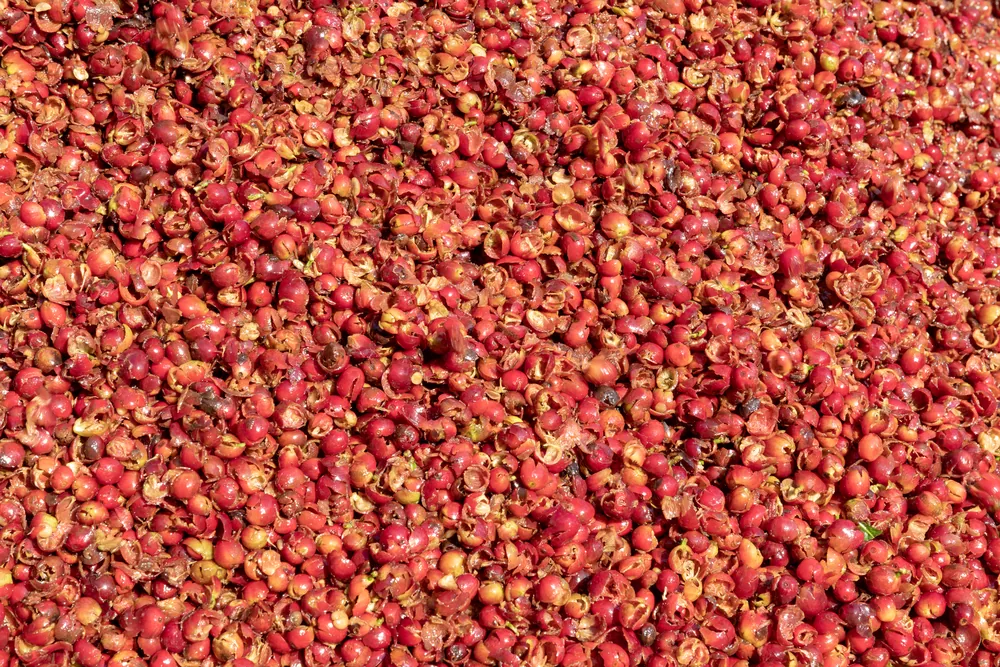
Red coffee cherries on a farm near Karatu, Arusha Region.
- Harvest
- 76,470 tonnes in 2025/26, up from 50,530 (Tanzania Coffee Board)
- Exports
- USD 420 million in the year to April 2026 (Bank of Tanzania)
- Growers
- About 320,000 smallholders produce some 90% of the crop (USDA)
- Types
- About 61% arabica, 39% robusta (USDA, 2025)
- Harvest season
- July to October
A smallholder crop
Coffee is grown in Tanzania on hundreds of thousands of family plots and very few estates. The US Department of Agriculture's 2025 report counts about 320,000 smallholders, who produce some 90 per cent of the crop, and around 100 large farms that produce the rest. The average plot is well under a hectare, and on it the trees are typically more than 25 years old.
The crop comes in two kinds. Arabica, about 61 per cent of the total in the USDA's figures, is grown in the highlands. It is washed or sun-dried, and the best of it sells as speciality coffee. Robusta, the rest, is grown in Kagera in the north-west. Most of it is sun-dried and sold for blends and instant coffee, some of which is made in Bukoba itself.
Tanzania drinks little of what it grows. The Coffee Board's development strategy puts home consumption at about 7 per cent of the crop, and tea is still the everyday drink. The USDA expects that to change only slowly, led by the cafés of Dar es Salaam and Arusha.
Where it grows
Coffee grows in three belts, each with its own way of farming it.
The north. On the slopes of Kilimanjaro and Mount Meru, in Kilimanjaro and Arusha, arabica is grown among bananas in the family gardens the Chagga call kihamba, on volcanic soil. This is the oldest arabica country and the source of the name. It is also the oldest in the other sense: the Coffee Board's strategy put the average age of Kilimanjaro's trees at over 40 years, against about 25 in the south, and yields have fallen with them. Smaller amounts come from Tanga's Usambara mountains.
The south. The southern highlands are now the heart of Tanzanian arabica. In June 2026 the Coffee Board's director general, Primus Kimaryo, said that Ruvuma and Songwe together produce 77.4 per cent of the country's arabica. The centres are Mbinga, in the Matengo highlands, and the Mbozi plateau in Songwe. Mbeya, Njombe and Iringa grow more. Here coffee is mostly grown on its own rather than under bananas.
The north-west. Kagera, on the western shore of Lake Victoria, grows almost all the robusta. As on Kilimanjaro, it is grown beneath bananas, in the Haya home garden, the kibanja. It is also where new planting is fastest: the USDA reports farmers in Ngara district clearing land for new coffee with subsidised seedlings.
| Belt | Regions | Coffee | How it is grown |
|---|---|---|---|
| North | Kilimanjaro, Arusha, Tanga | Arabica | Under bananas, on the volcanic slopes |
| South | Ruvuma (Mbinga), Songwe (Mbozi), Mbeya, Njombe, Iringa | Arabica, most of the national crop | Mostly on its own |
| North-west | Kagera | Robusta | Under bananas, on the lake shore |
Smaller amounts are grown in Kigoma, Morogoro, Mara and several other regions.
From chewed beans to cooperatives
Coffee was in Tanzania before the Europeans. In the Haya kingdoms of what is now Kagera, robusta was grown under the control of the kings, and its beans were boiled and chewed, not brewed, as the anthropologist Brad Weiss describes. The German colonial government turned it into a cash crop, and pushed farmers to grow it for sale.
Arabica came from outside. Catholic missionaries planted it in the 1890s at the mission at Kilema, on Kilimanjaro, and German settlers followed with estates. The Chagga took it up on their own farms, and in the 1920s they formed the Kilimanjaro Native Planters' Association to sell it themselves. It became the Kilimanjaro Native Co-operative Union in the early 1930s, the oldest cooperative in the country. The KNCU still buys Kilimanjaro coffee, from its headquarters in Moshi.
Independent Tanzania took control of the trade. In 1977 the government abolished the cooperative unions and handed coffee to a state authority, and the unions were not restored until 1984. The industry was liberalised in the early 1990s, and private buyers began to compete with the cooperatives. Production, however, barely moved. The Coffee Board's own strategy says the national harvest stayed at about 50,000 tonnes a year for 35 years.
How it is sold
Most Tanzanian coffee is sold at auction. Farmers deliver to their village cooperative, known as an AMCOS (Agricultural Marketing Cooperative Society), which offers the coffee at auctions run by the Tanzania Coffee Board. Licensed buyers bid, and the farmers are paid from the proceeds. The oldest auction is in Moshi, where the Coffee Board has its headquarters. Regional auctions are now held in the growing areas too, and bidding is online. The best coffee can also go to buyers abroad by direct export, under a Coffee Board licence.
The present system dates from January 2018, when Prime Minister Kassim Majaliwa revoked the licences of private traders who bought coffee directly from farmers, and ordered that it go through the cooperatives and the auction. The aim was to protect farmers from middlemen and to stop coffee being smuggled across the borders. Private buyers argued that it cut them off from the farmers they had worked with, and the first harvest under the new rules was sold late. The arguments continue. The Coffee Board's strategy itself says that the delay between the farm gate and payment at auction can leave farmers with low prices.
"Kilimanjaro" in Japan
In Japan, Tanzanian coffee is sold as Kilimanjaro, and the name sells. The label once meant coffee from the mountain itself. According to the Coffee Board, the All Japan Fair Trade Council decided in 1991 that all Tanzanian coffee could carry it, wherever in the country it was grown, and so could any blend containing at least 30 per cent Tanzanian beans.
Japan is still one of the two biggest buyers. In 2024, on figures in the USDA report, the European Union took about 653,000 bags of Tanzanian green coffee and Japan about 200,000. Sales to the United States, China and India have grown fastest since 2021.
A record harvest, and the target it missed
The last few seasons have been good ones. World coffee prices rose sharply from 2024, and the Coffee Board has been handing out millions of new seedlings to replace old trees. In 2025/26 Tanzania harvested 76,470 tonnes of coffee, the Coffee Board says, up from 50,530 tonnes the season before. Coffee exports earned USD 420 million in the year to April 2026, according to the Bank of Tanzania, making coffee the fourth-largest crop export after tobacco, cashew and horticulture.
It is still far short of the plan. The National Coffee Development Strategy of 2020 set a target of 300,000 tonnes by 2025/26, nearly four times what was harvested. The Coffee Board's next goal is 85,000 tonnes for 2026/27.
Figures differ by source. The US Department of Agriculture estimates in 60-kg bags and put the 2025/26 crop at 1.45 million bags, about 87,000 tonnes. This page uses the Coffee Board's figures for the harvest.
Seeing it
The coffee farms are among the easiest working farms in the country to visit. Villages on the slopes above Moshi take visitors through the whole process, from picking to roasting, usually alongside a walk to a waterfall. Around Karatu, between Lake Manyara and Ngorongoro, several estates take guests. In the south, the Mbinga highlands are coffee country from end to end, if a long way from anywhere.
The harvest, and the busiest time on the farms, runs from July to October.
- Where is coffee grown in Tanzania?
- Arabica in the highlands: on Kilimanjaro and Mount Meru in the north, and in the southern highlands of Ruvuma (Mbinga), Songwe (Mbozi), Mbeya and Njombe, which now produce most of it. Robusta is grown in Kagera, near Lake Victoria.
- Does Kilimanjaro coffee come from Kilimanjaro?
- Not necessarily. Since 1991 the All Japan Fair Trade Council has allowed any Tanzanian coffee to be sold in Japan as Kilimanjaro, as well as blends with at least 30 per cent Tanzanian beans. Ruvuma and Songwe, in the far south, produce 77.4 per cent of the country's arabica, according to the Tanzania Coffee Board.
- How much coffee does Tanzania produce?
- 76,470 tonnes in the 2025/26 season, up from 50,530 tonnes in 2024/25, according to the Tanzania Coffee Board.
- Who buys Tanzanian coffee?
- The European Union is the largest buyer, followed by Japan. In 2024 the EU took about 653,000 bags and Japan about 200,000, according to the US Department of Agriculture. The United States, China and India are growing markets.
- How is coffee sold in Tanzania?
- Farmers sell through their village cooperatives (AMCOS), which offer the coffee at auctions run by the Tanzania Coffee Board, in Moshi and in the growing regions. Licensed buyers bid. Some high-grade coffee is exported directly under a Coffee Board licence.
- When is the coffee harvest in Tanzania?
- July to October.
Last reviewed 2026-09-22
Editorial — fact-check complete
Checked against
- Global coffee price rally unlocks new opportunities for Tanzania (11 June 2026) — Coffee Board production figures and the Ruvuma–Songwe shareThe Citizen
- Tanzania Coffee Annual 2025US Department of Agriculture, Foreign Agricultural Service
- Monthly Economic Review, May 2026 — Table A6, Exports of Goods (year ending April)Bank of Tanzania
- Tanzania Coffee Industry Development Strategy 2020/21–2024/25Tanzania Coffee Board
- Tanzania coffee farmers and traders face stark new regulatory reality (May 2018)Daily Coffee News
- Tanzania coffee farmers earn over US$10.98M as Kagera coffee auctions deliver strong prices (July 2026)Food Business Middle East & Africa
- Auctions and direct exportTanzania Coffee Board
- Sacred Trees, Bitter Harvests: Globalizing Coffee in Northwest TanzaniaBrad Weiss, Heinemann (2003), via Utah State University
- Coffee at Kilema — introduction of arabica by Catholic missionariesntz.info
- The Kilimanjaro Native Planters Association: administrative responses to Chagga initiatives in the 1920sAfricaBib (Transafrican Journal of History)
- Kilimanjaro Native Co-operative Union — 1977 dissolution, 1984 restoration, liberalisationWikipedia