Njombe
A cold, green highland town at nearly 2,000 metres, surrounded by tea, pine and avocado country — the gateway to the flowering plateau of Kitulo and the empty shore of Lake Nyasa below the Livingstone Mountains.
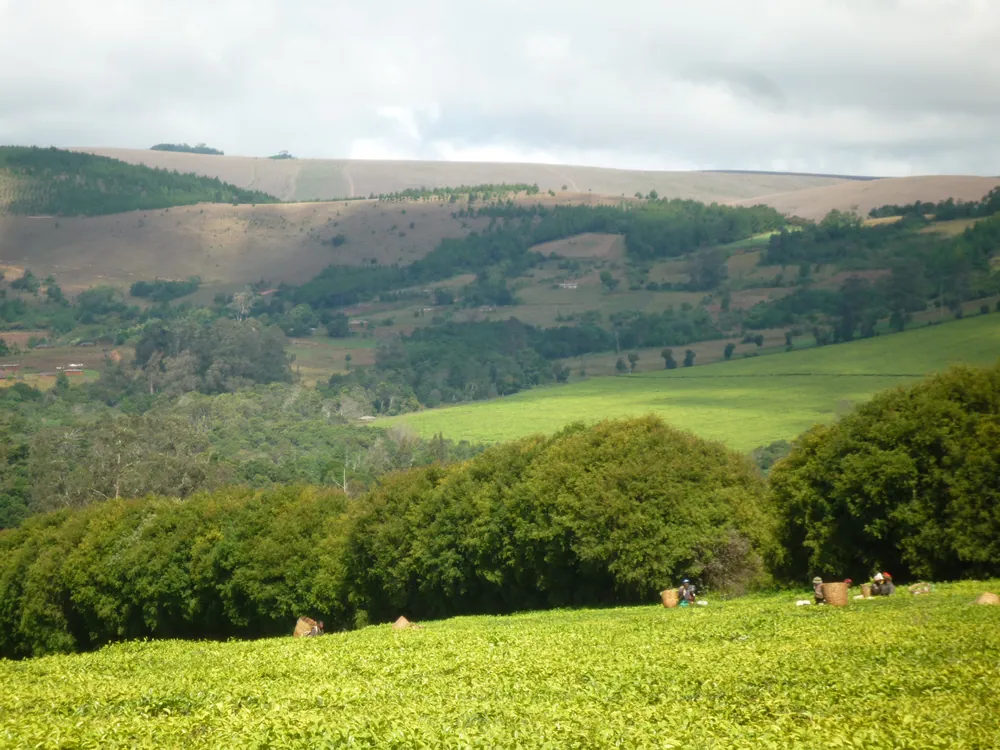
Tea fields in Ludewa District. The Njombe highlands are cool, wet and among the most productive farmland in Tanzania.
- Region
- Njombe Region, southern highlands
- Population
- 182,127, Njombe Town (2022 census)
- Elevation
- Nearly 2,000 m
- Region created
- 2012, from Iringa Region
- Road
- On the trunk road from Makambako to Songea
An old highland, a young region
Njombe is the country of the Bena, a people of the high plateau who lived, before the colonial period, in villages each under its own ruler. In the nineteenth century they were drawn into the wars of their more powerful neighbours: first the Sangu conquered them and installed their own royal family as chiefs, and then the Hehe of Iringa conquered the Sangu, and the Bena with them.
German rule reached the plateau in the late 1890s. One Bena king chose to lead his people down off the highland into the lowlands rather than live under it. Catholic and Lutheran missions followed, and in 1968 the Catholic Church created the Diocese of Njombe out of the territory of the Benedictine abbey at Peramiho.
The region itself is new. For most of Tanzania's history Njombe was a district of Iringa Region, and it became a region in its own right only in 2012, with Njombe town as its capital. It includes the high Makete plateau, the Ludewa district running down to Lake Nyasa, Wanging'ombe, and the railway town of Makambako on the TAZARA line.
Potatoes, pine, and the avocado rush
What the region produces
- Irish potatoes
- A staple crop of the cool highland
- Avocados
- Hass, grown for export
- Tea
- Large estates on the hills
- Timber
- Pine and eucalyptus plantations
- Iron & coal
- Liganga and Mchuchuma, Ludewa
Cool temperatures, high rainfall and good soils make Njombe one of Tanzania's most productive farming regions. Irish potatoes, maize and wheat do well here, tea is grown on large estates, and plantations of pine and eucalyptus cover whole hillsides — the result of a timber boom that made tree-growing a common investment for farmers.
The newest crop is the Hass avocado. As timber prices fell, many farmers replaced pine, maize and potatoes with avocado trees, and Njombe has become the centre of an export industry, with growers recently cleared to ship to China. One research paper frames the change as a move from timber rush to avocado rush.
Under the hills of Ludewa lie reserves that could change the region again: the Liganga iron-ore deposit, estimated by the state National Development Corporation at about 126 million tonnes, and the Mchuchuma coalfield beside it. A joint venture to mine them and build a steelworks was signed in 2011 but stalled for years over its terms; it remains one of the country's most discussed industrial projects.
Garden of God, and a lake without visitors
The region's peoples include the Bena, the largest, and the Kinga, Pangwa and Wanji. Life here is agricultural and largely Christian, and the town has a firm reputation for cold — something that surprises visitors who packed for the coast.
West of the town, the Kitulo plateau in Makete sits at around 2,600 metres. Its grasslands are protected as Kitulo National Park, established in 2002, and between December and April they flower with orchids, aloes, irises and red-hot pokers — the reason local people call it the Bustani ya Mungu, the Garden of God. The park is shared with Mbeya Region.
Further south the highlands end in the Livingstone Mountains, which fall steeply to Lake Nyasa. Ludewa District has a long, almost undeveloped stretch of lakeshore — the beaches at Lupingu among them — reached by long, rough roads. It is some of the least visited country in Tanzania, and among the most beautiful.
Towns, parks and places across Njombe Region
Town
Makambako
A junction town on the TAZARA railway and the Dar es Salaam–Mbeya highway, where the road to Njombe and Songea turns south.
Town
Makete
The district town of the high plateau, and the way in to Kitulo National Park.
Town
Ludewa
The district town above Lake Nyasa, near the Liganga iron and Mchuchuma coal deposits.
Informational — none of this is ticketed by us
National park
Kitulo National Park
A high plateau of orchids and wildflowers, best December to April. In Makete District, shared with Mbeya Region.
Working farms
The tea country
Estates and smallholdings across the green hills of the region — the landscape Njombe is known for.
Lakeshore
Lupingu and the Nyasa shore
Beaches beneath the Livingstone Mountains in Ludewa District. Remote, simple, and very rarely visited.
Mountains
Livingstone Mountains
The steep range above Lake Nyasa's north-eastern shore, for walking with a local guide.
Landscape
Liganga
The hills above the Liganga iron-ore deposit in Ludewa District, in green, farmed country.
Protected area
Mpanga-Kipengere Game Reserve
Highland grassland, forest and waterfalls in Makete District, near Kitulo. Little infrastructure; go with a guide.
Before you go
- Getting there
- By road. Njombe is south of Makambako on the paved road to Songea; Makambako is on the main Dar es Salaam–Mbeya highway and the TAZARA railway. The nearest scheduled flights are to Mbeya or Songea.
- Getting around
- Kitulo, Ludewa and the lake need a sturdy vehicle and a driver who knows the rural roads.
- When to come
- June to October is dry and best for the roads. Kitulo flowers December to April, in the rains.
- Climate
- Cold. Nights can approach freezing on the high plateau in June and July — bring warm layers and a rain jacket.
- Lake Nyasa
- Facilities on the Ludewa shore are very basic. Plan fuel, cash and accommodation before you set off.
- Money
- Shillings. ATMs in Njombe and Makambako; carry cash for everywhere else.
Last reviewed 2026-09-15
Editorial — fact-check complete
Checked against
- 2022 Population and Housing Census — administrative unitsNational Bureau of Statistics, Tanzania
- Liganga iron and steel projectNational Development Corporation
- Kitulo National ParkTanzania National Parks (TANAPA)
- Njombe Region — creation, districts, peoples, protected areasWikipedia
- Bena of Southwestern TanzaniaEncyclopedia of World Cultures
- From timber rush to avocado rush? Southern Highlands, TanzaniaGeoforum (ScienceDirect)
- Peramiho Abbey — history, and the dioceses of Njombe and SongeaMissionary Benedictines, Peramiho
- Govt: our goals in the Liganga-Mchuchuma dealThe Citizen
- TPHPA helps Njombe avocado and potato firms access the China marketThe Respondents
- Njombe: where opportunity grows from the land and the peopleDaily News