Mining in Tanzania
Mining is now a tenth of Tanzania's economy and gold is its biggest export by far. What comes out of the ground and where, who digs it, how the 2017 laws changed the terms, why the central bank now buys gold, and the new minerals that may change the map.
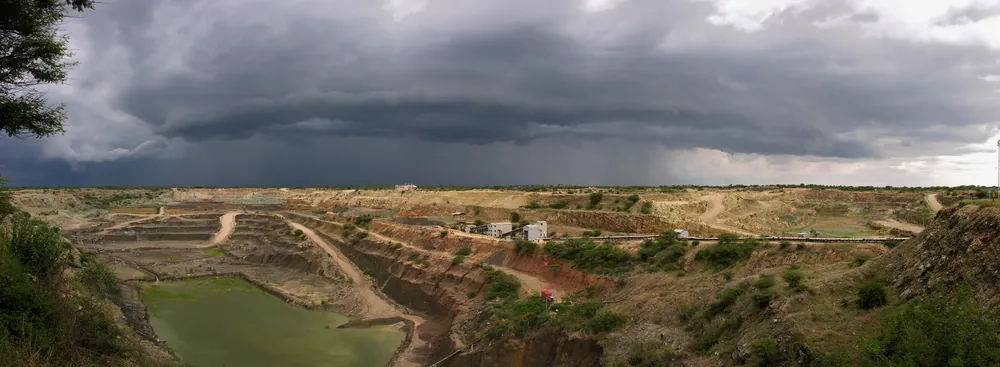
The open pit of the Williamson diamond mine at Mwadui, Shinyanga, worked since the 1940s.
- Share of GDP
- 10.1% in 2024, up from 9.1% in 2023 (Ministry of Minerals)
- Gold exports
- USD 5.52 billion in the year to June 2026 — about 47% of goods exports (Bank of Tanzania)
- Gold output
- 67.8 tonnes in 2025/26 (Ministry of Minerals)
- State's stake
- At least 16% of every large mine, free, since 2017
- Regulator
- The Mining Commission, under the Ministry of Minerals
What comes out of the ground
Tanzania mines a long list of things, but one of them outweighs the rest. Gold earned USD 5.52 billion in the year to June 2026, according to the Bank of Tanzania — about 47 per cent of everything the country exported as goods, and more than tobacco, coffee, cashew and every manufactured product put together. Official output for the 2025/26 financial year was 67.8 tonnes. Read more on the gold page.
Around it sits a mineral economy that is unusually varied. Tanzanite comes from a single hill at Mererani and nowhere else on earth (see tanzanite). Diamonds have come from the Williamson mine at Mwadui since the 1940s. There is coal in the south-west, iron ore in Njombe, graphite on the southern coast, nickel in the far north-west, uranium in Ruvuma and helium under the Rukwa rift — and a long tail of coloured gemstones, gypsum, limestone for cement, and building stone.
Taken together, mining and quarrying reached 10.1 per cent of GDP in 2024, up from 9.1 per cent in 2023. The Minister of Minerals, Anthony Mavunde, noted that the target of 10 per cent set in the 2009 Mineral Policy and the five-year development plan had been due only in 2026. In 2019 the share was 5.2 per cent. In five years the sector roughly doubled its weight in the economy.
A history in four finds
Gold, 1909. The first gold mine in the territory opened at Sekenke, in present-day Singida Region, in 1909. During the First World War its gold was carried to Tabora and struck into emergency coins. In the 1920s a rush on the Lupa goldfields founded the town of Mbeya, and artisanal miners still work gold around Chunya today.
Diamonds, 1940. In March 1940 the Canadian geologist John Williamson found a kimberlite pipe at Mwadui, in Shinyanga. It proved to be the largest economically workable diamond pipe in the world, and a pink stone from it was given to Princess Elizabeth as a wedding present in 1947.
Tanzanite, 1967. A blue-violet zoisite turned up in the Mererani Hills in Manyara. Tiffany & Co. named it for the country the following year.
The gold boom, from 2000. Modern industrial gold mining arrived around the turn of the century: the Geita mine restarted in 2000 and North Mara began production in 2002, and the Lake Zone became the centre of Tanzanian gold. That is the economy the rest of this page describes.
Two kinds of mining, side by side
There are two mining industries in Tanzania, and they barely resemble each other.
The first is large-scale and industrial: open pits and underground mines run by international companies, with the state as a partner. The biggest are Geita, operated by AngloGold Ashanti in Geita Region, and the Barrick mines of North Mara in Mara and Bulyanhulu near Kahama in Shinyanga. In 2017 the large mines employed about 12,000 people.
The second is artisanal and small-scale: pits sunk by hand, family claims, cooperatives and small licence-holders, spread across hundreds of sites. The US Geological Survey cites an estimate of as many as 1.5 million artisanal miners. They produce gold, most coloured gemstones and much else. Until recently much of their gold left the country unrecorded.
That changed in March 2019, when the government opened 28 mineral-trading centres in mining districts so that small-scale miners could sell legally, close to where they dig. Recorded sales of gold from small-scale mines rose from 337 kg in 2016 to 4,660 kg in 2019. The Ministry of Minerals put small-scale miners at close to 40 per cent of the sector's revenue in 2022/23, up from about 5 per cent before the 2017 reforms.
2017: the year the terms changed
In July 2017 Parliament passed three laws that rewrote the relationship between the state and the mining companies: the Natural Wealth and Resources (Permanent Sovereignty) Act, a companion act allowing the government to renegotiate "unconscionable" contract terms, and amendments to the Mining Act 2010.
The core changes were these. The government takes a non-dilutable free carried interest of at least 16 per cent in every large mining project. Royalties on gold, copper, silver and platinum went up from 4 to 6 per cent, and those on diamonds and gemstones from 5 to 6 per cent. A new Mining Commission took over licensing and inspection. Unprocessed mineral concentrates were banned from export to force processing at home (the ban was lifted in 2019).
The collision that followed was with Acacia Mining, then the operator of North Mara, Bulyanhulu and Buzwagi, over concentrate exports and tax. It ended when Barrick bought out Acacia and, in 2019, agreed a settlement with the government: USD 300 million to close the disputes, the government's 16 per cent in each mine, and the economic benefits split 50/50 between the state and Barrick. The mines are now run by Twiga Minerals, the joint company created for the purpose.
Whether the reforms were a model or a warning was argued about for years. The output figures since 2019, and the fact that investment has continued, are the government's answer.
Gold into the reserves
The newest turn is monetary. Under regulations in force from October 2024, miners and gold dealers must set aside at least 20 per cent of their gold for sale to the Bank of Tanzania, through domestic refineries, at market prices. The aim is to build foreign reserves in gold instead of dollars.
It has moved fast. In 2025/26 the Bank bought 21,710 kg, which was 75.6 per cent of the 28,701 kg sold through the country's five domestic refineries. By June 2026 it held about 27.5 tonnes of gold.
One consequence is that more gold is now refined in Tanzania, at plants including those in Mwanza and Dodoma, rather than exported raw. Refining at home was one of the stated goals of the 2017 laws.
What comes next: the new minerals
Most of the talk in the industry now is about minerals that are not gold, the so-called critical minerals used in batteries and power.
Graphite. The Lindi Jumbo mine in Lindi Region shipped its first graphite concentrate in 2024, the first graphite mine in the country to reach production, with a planned output of 40,000 tonnes a year.
Uranium. At the Mkuju River project in Namtumbo district, Ruvuma, Rosatom's subsidiary Mantra Tanzania opened a pilot processing plant on 31 July 2025. The main plant, designed for up to 3,000 tonnes of uranium a year, is scheduled for commissioning in 2029, and the government holds 20 per cent.
Nickel. The Kabanga deposit in Ngara district, Kagera, holds nickel with copper and cobalt. Lifezone Metals plans a mine there and a refinery at Kahama. As of mid-2026 the project was still waiting for its final investment decision.
Iron, coal and helium. Under Ludewa in Njombe lie the Liganga iron-ore and Mchuchuma coal deposits, long planned as a steel project and long stalled. The Ngaka coal mine in Ruvuma already supplies cement plants. And in 2016 explorers announced significant helium in the Rukwa basin (Rukwa); whether it becomes an industry is still open.
Where it happens
Mining is concentrated in the Lake Zone for gold and spread across the south and west for everything else. The region guides carry a short note on each and link back here.
| Mineral | Where | Status |
|---|---|---|
| Gold | Geita; Tarime (Mara); Kahama (Shinyanga); Chunya (Mbeya); many small-scale fields | Producing |
| Tanzanite | Mererani, Simanjiro (Manyara) | Producing — the only source on earth |
| Diamonds | Mwadui, Kishapu (Shinyanga) | Producing |
| Coal | Ngaka, Mbinga (Ruvuma) | Producing |
| Graphite | Lindi Jumbo (Lindi) | Producing since 2024 |
| Uranium | Mkuju River, Namtumbo (Ruvuma) | Pilot plant since 2025 |
| Nickel | Kabanga, Ngara (Kagera) | In development |
| Iron ore | Liganga, Ludewa (Njombe) | Undeveloped |
| Helium | Rukwa basin (Rukwa) | Exploration |
You cannot tour working mines as a casual visitor. The mines are closed industrial sites, and small-scale pits are workplaces. Visit them only with local agreement.
What is argued about
Mining brings in more money than anything else Tanzania sells abroad, and it causes some of its sharpest disputes. Communities around the large mines have argued with the operators for years over land, water, compensation and the conduct of mine security. Around North Mara in particular, people have died in incidents on the site (see Mara). Small-scale mining brings its own problems: dangerous shafts, unregulated processing, and land that is dug up and left.
Then there is the question every mineral economy faces: how much of the value stays. The 2017 laws, the free carried interest, the trading centres, the refineries and the central-bank gold programme are all attempts to answer it. The tanzanite trade shows the same question in miniature, in the distance between what a miner at Mererani is paid and what the stone sells for in a foreign showroom.
- What minerals does Tanzania mine?
- Mainly gold, which is by far the largest, along with tanzanite (found nowhere else), diamonds, coal, graphite, coloured gemstones and industrial minerals. Uranium, nickel and helium projects are at pilot, development or exploration stage.
- How much of Tanzania's economy is mining?
- 10.1 per cent of GDP in 2024, according to the Ministry of Minerals, up from 9.1 per cent in 2023 and 5.2 per cent in 2019.
- How much gold does Tanzania produce?
- 67.8 tonnes in the 2025/26 financial year, according to the Ministry of Minerals. Gold exports were worth USD 5.52 billion in the year to June 2026.
- Does the Tanzanian government own the mines?
- It holds a free, non-dilutable stake of at least 16 per cent in every large mine under the 2017 laws. At the Barrick mines, run by Twiga Minerals, the economic benefits are split 50/50 with the state.
- Can tourists visit a mine in Tanzania?
- Not as a casual visit. Large mines are closed industrial sites, and small-scale pits should be visited only with local agreement.
Last reviewed 2026-09-21
Editorial — fact-check complete
Checked against
- Tanzania's mining sector surpasses GDP target, hits 10.1 percent contribution (23 April 2025)The Citizen
- Exports grow 17.2% to USD 19.9 billion in year ending June 2026 — from the Bank of Tanzania Monthly Economic Review, July 2026TanzaniaInvest
- Gold production reaches 67.8 tonnes, central bank buys 75.64% (Commissioner for Minerals to Parliament, 11 August 2026)TanzaniaInvest
- Bank of Tanzania accumulates 27.5 tonnes of gold under domestic programme (June 2026)The Chanzo
- Tanzania orders gold dealers to reserve 20% for purchase by central bank (September 2024)Mining Weekly
- The Mineral Industry of Tanzania, 2019 — laws, trading centres, artisanal mining, minesUS Geological Survey, Minerals Yearbook
- The launch of Twiga Minerals heralds partnership between Tanzanian government and BarrickBarrick
- Tanzania mining sector overview, including small-scale miners' shareTanzaniaInvest
- First graphite concentrate shipment completed — Lindi Jumbo (July 2024)Mining Weekly
- Lindi Jumbo: Tanzania's first graphite mine on track to productionMining Review Africa
- Pilot uranium processing plant launched in Tanzania (31 July 2025)World Nuclear News
- Lifezone Metals files Initial Assessment for the Kabanga Nickel Project (June 2025)Lifezone Metals