Shinyanga
Sukuma country south of Lake Victoria: cotton, cattle and maize on a dry plateau, the largest economically workable diamond pipe in the world, and one of Africa's most successful pieces of land restoration.
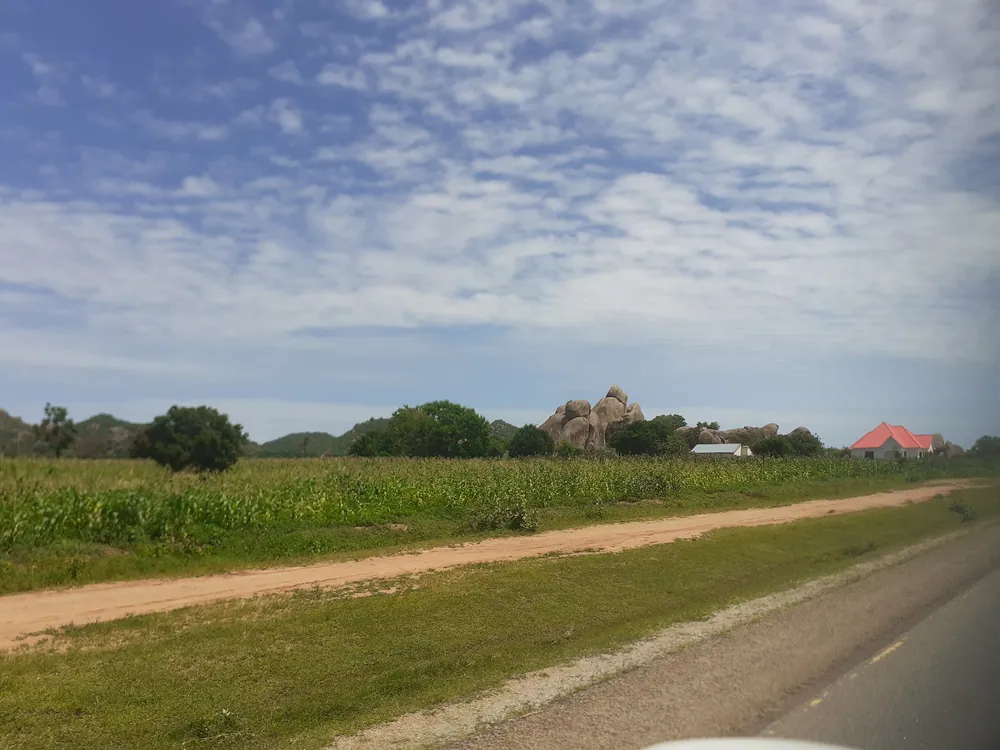
Maize fields and granite outcrops in Shinyanga Region. The plateau is dry, farmed hard, and dotted with rock.
- Region
- Shinyanga Region, Lake Zone
- Population
- 2,241,299 (2022 census)
- Capital
- Shinyanga
- People
- Sukuma, with Nyamwezi and Sumbwa
- Known for
- Diamonds, gold, cotton and cattle
The pipe at Mwadui
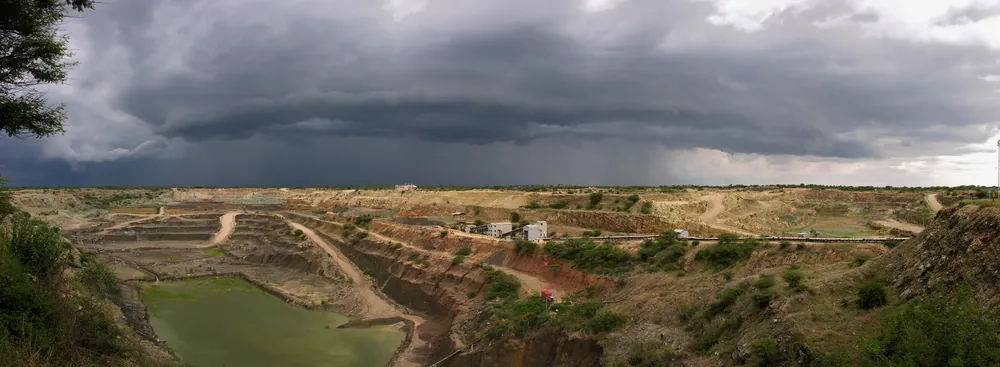
In March 1940 a Canadian geologist, John Williamson, found a kimberlite pipe at Mwadui, north-east of Shinyanga town. It turned out to be the largest economically workable diamond-bearing pipe in the world — about 146 hectares at the surface — and the first major diamond mine outside southern Africa.
The mine made the region famous. A 54.5-carat pink diamond found here was presented to Princess Elizabeth on her wedding in 1947; it is still one of the best-known stones in the British royal collection. Since 2009 the mine has been held by Petra Diamonds with a 25% government share, and production has fallen a long way from its peak — it was mothballed in April 2020 when diamond prices collapsed.
Diamonds are not the only mineral here. The Kahama area in the west holds two of the country's significant gold mines, Bulyanhulu and Buzwagi, and the mining economy has reshaped that end of the region over the last three decades.
Cotton, cattle, and the trees that came back
What the region lives on
- Cotton
- The Lake Zone's historic cash crop
- Cattle
- Large herds, central to Sukuma life
- Maize & rice
- The staple crops
- Diamonds
- Mwadui, in Kishapu District
- Gold
- Bulyanhulu and Buzwagi, near Kahama
Around 80% of the workforce farms. Cotton is the cash crop, maize and paddy the staples, and cattle are both wealth and insurance — the Sukuma are among the largest cattle-keeping peoples in East Africa, and herds shape how land is used everywhere in the region.
That pressure nearly destroyed it. By the 1980s Shinyanga was so heavily cleared and eroded that it was being called the desert of Tanzania. From 1986 to 2004 a government programme, HASHI (Hifadhi Ardhi Shinyanga), worked with villages to revive ngitili — the Sukuma practice of enclosing land to regrow grass and trees as dry-season fodder.
It worked on a scale almost nothing else has. By 2004 at least 350,000 hectares of ngitili had been restored or created across 833 villages, and the programme was recognised at the 2002 World Summit on Sustainable Development. Ngitili is now the standard example, worldwide, of restoration led by customary practice rather than imposed on it.
Sukuma
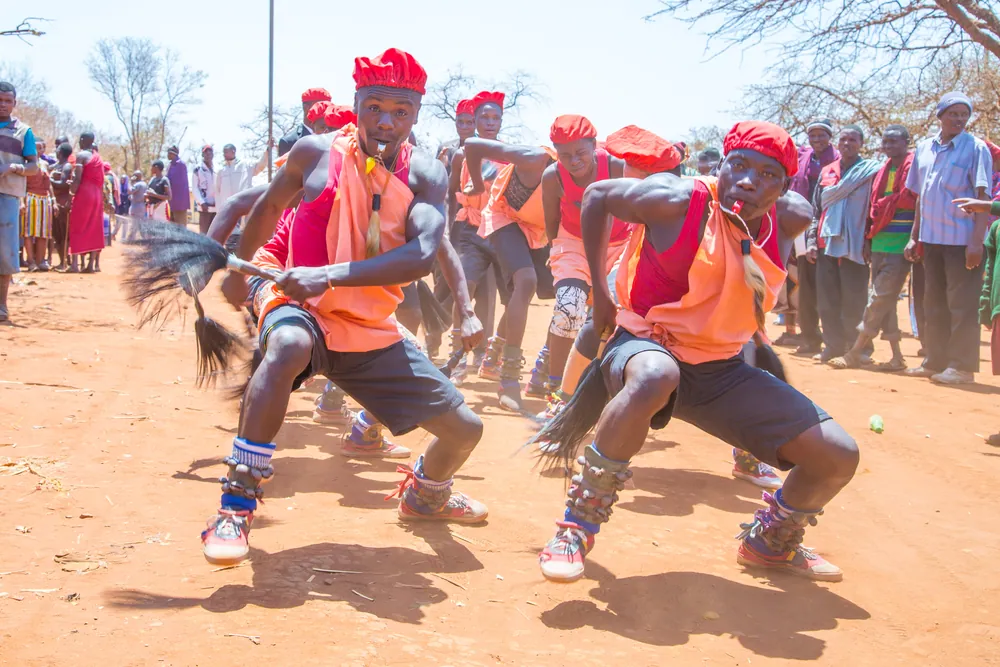
The Sukuma are Tanzania's largest ethnic group, and this is the middle of their country. Sukuma life is agricultural and pastoral, organised around the household, the herd and the village, and it has a public culture of remarkable energy: dance societies — historically the bagika and bagalu — compete against each other after the harvest, with dances built around animals, farming tools and medicine.
The competitive season runs from about June, when the fields allow it. The best-known spectacle, bugobogobo, is a dance of courage and herbal knowledge performed with live snakes; the museum that documents all of this best is at Bujora, over the border in Mwanza Region.
The towns are practical places: Shinyanga itself on the road and railway, Kahama grown on gold, and Mwadui, which is really a mine with a town attached. The rewarding part of the region is the country between them — granite outcrops, ngitili woodland, and herds moving at dusk.
Towns, parks and places across Shinyanga Region
Mining town
Mwadui
The Williamson diamond mine and its company town, in Kishapu District about 23 km north-east of Shinyanga.
Town
Kahama
The region's western town, on the Central Corridor road, grown around the Bulyanhulu and Buzwagi gold mines.
National park
Kigosi National Park
Miombo and the Moyowosi–Kigosi wetlands in the south-west, shared with Geita and Kigoma regions.
Restored landscape
Ngitili woodlands
Enclosed grazing reserves across the region — the everyday form of the restoration that made Shinyanga famous.
Town
Shinyanga town
The regional capital: a market, a railway station on the Central Line branch to Mwanza, and the base for the region.
Informational — none of this is ticketed by us
Industry
Mwadui — the Williamson mine
The largest workable diamond pipe on earth, found in 1940. Not open to casual visitors, but the scale is visible from the road.
Restored landscape
Ngitili country
Village enclosures where woodland has grown back since the 1980s — dry-season fodder, firewood and shade.
Living culture
Sukuma dance
Competitive dancing after the harvest, from about June. Ask locally; these are village events, not performances laid on for visitors.
National park
Kigosi National Park
Remote wetland and woodland on the region's south-western edge.
Town
Kahama
Gold country, and a staging post on the long road west towards Rwanda, Burundi and Kigoma.
Landscape
The granite outcrops
Rock domes standing out of the farmland — the same geology that made Mwanza's boulders famous.
Before you go
- Getting there
- By road from Mwanza, about three hours north, or from Dodoma on the central route. Trains on the Central Line's Mwanza branch stop at Shinyanga.
- Getting around
- A vehicle and driver. Distances are long and villages are spread out.
- When to come
- May to October is dry. Rain falls between about October and May and can make rural tracks difficult.
- Climate
- Hot and dry: roughly 600–900 mm of rain a year. Carry water.
- Mining areas
- Mines are private and closely guarded. Do not photograph installations or approach workings.
- Money
- Shillings. ATMs in Shinyanga and Kahama; carry cash in the villages.
Last reviewed 2026-09-17
Editorial — fact-check complete
Checked against
- 2022 Population and Housing Census — administrative unitsNational Bureau of Statistics, Tanzania
- Shinyanga Region — districts, economy, miningWikipedia
- Williamson diamond mine — discovery, size, ownershipWikipedia
- Shinyanga Soil Conservation Programme (HASHI) — ngitili restorationEquator Initiative, UNDP
- The Shinyanga revolution: restoring 300,000 hectaresWorld Agroforestry (ICRAF)