Tanzanite: the stone found only in Tanzania
Tanzanite comes from one hill in northern Tanzania and nowhere else on earth. What it is, how it is mined at Mererani, what drives the price, how to buy without being cheated, and the rules on taking it home.
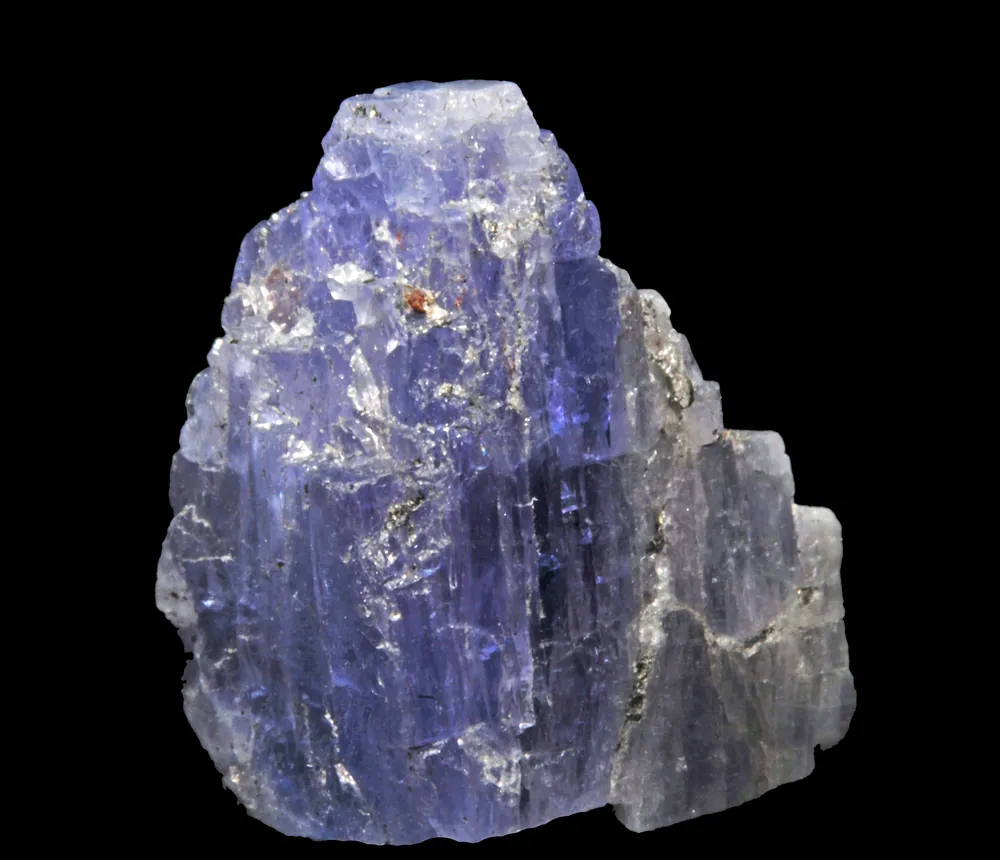
A tanzanite crystal. Every stone on the market came out of a strip of ground about 7 km long at Mererani.
- What it is
- The blue-violet variety of the mineral zoisite
- Where
- Mererani, Simanjiro district, Manyara region — a strip about 7 km by 2 km
- Found
- 1967; named by Tiffany & Co. in 1968
- Hardness
- About 6.5 on the Mohs scale — softer than quartz
- Rough export limit
- Two grams per stone, under the 2019 value-addition guidelines
What tanzanite actually is
Tanzanite is the violet-blue variety of zoisite, a calcium aluminium silicate. What makes it blue is a trace of vanadium. What makes it unusual to look at is pleochroism: the crystal shows different colours down different axes. Gemological work published in 1969 recorded three — red-violet, deep blue and yellow-green — which is why the same stone can look blue from one angle and violet from another.
That property decides how the stone is cut. A cutter who orients for the rarer violetish blue throws away more of the crystal; one who orients for violet-purple keeps more weight. The market pays more for the blue, so the cut you are shown is a commercial decision as much as an aesthetic one.
It is a soft gem by jewellery standards — around 6.5 on the Mohs scale, against 9 for sapphire. It does not like knocks, sudden temperature change or ultrasonic cleaners. It is a fine stone for earrings and pendants and a demanding one for a ring worn every day.
Tanzanite was named a December birthstone by the American Gem Trade Association in 2002 — the first stone added to the list since 1912.
One hill, and nowhere else
Every tanzanite on earth has come out of a deposit at the Mererani Hills in Simanjiro district, Manyara region, in the foothills south-east of Kilimanjaro. The mineralised strip is roughly 7 km long and 2 km wide, inside a mining field of about 8 km². There is no second source. Prospecting elsewhere has never produced a commercial deposit.
Since 1990 the field has been divided into four blocks, A, B, C and D. Blocks A and C went to large operators; B and D were reserved for Tanzanian small-scale miners. Most of the people working at Mererani are artisanal miners, sinking narrow shafts by hand, and most of the stone that reaches the market passes through brokers at the pit head before it reaches a dealer in Arusha.
Between July 2017 and April 2018 the government walled the field in: a 24 km perimeter fence with controlled gates, built to stop stone leaving without tax being paid. It is the most visible piece of mining policy in the country, and it changed how the trade works far more than any price movement has.
How it was found, and how it got its name
The stone was identified in 1967. Who found it first is genuinely disputed: the Tanzanian tailor and prospector Jumanne Mhero Ngoma is recorded as finding it in January of that year, and the Goan prospector Manuel de Souza as finding transparent fragments that July. Both accounts are still argued over in Tanzania, and the dispute matters locally in a way it does not to the foreign trade.
What is not disputed is the name. In 1968 Tiffany & Co. took the stone to market, and Henry B. Platt named it tanzanite after the country — the company judged that "blue zoisite" would not sell. Tiffany's campaign is the reason the stone was known in New York before it was known in most of Tanzania.
Why almost every tanzanite has been heated
Most zoisite comes out of the ground brownish. Heating it to roughly 500–600 °C changes the oxidation state of the vanadium, burns off the brown and leaves the blue-violet the market wants. Nearly all tanzanite in jewellery has been through this.
This is not a scandal and it is not a defect. It is a stable, permanent, industry-standard treatment, and the major laboratories treat it as assumed rather than flagging it on every report. It does mean two things for a buyer: an untreated stone in a strong blue is genuinely rare and priced accordingly, and any seller who tells you their stone is "natural, never heated" while pricing it as ordinary tanzanite is telling you something that is almost certainly not true.
What it costs — and why nobody can quote you an official price
There is no official tanzanite price. No government body, exchange or laboratory publishes a per-carat price list, the way there is for gold. Prices come from dealers, and they vary with colour, size, cut, the buyer's leverage and, frankly, whether the seller thinks you know what you are looking at.
The ranges below are indicative retail figures from trade price guides as at September 2026, for heat-treated stones. Use them to know when a price is absurd, not to argue a dealer down to the shilling. Price per carat rises with size: a 3-carat stone costs more than three times a 1-carat stone of the same quality, because the colour is deeper and large rough is scarcer.
| Size | Commercial colour | Fine colour | Note |
|---|---|---|---|
| Under 1 ct | USD 50–150 | USD 150–250 | Pale, often greyish; melee and cluster work |
| 1 ct | USD 100–200 | USD 200–350 | The common engagement-ring size |
| 2 ct | USD 200–350 | USD 400–550 | Colour begins to deepen noticeably |
| 3 ct and above | USD 300–500 | USD 500–675+ | Where the intense violetish blues appear |
Prices for gemstones move. Treat any figure on any website, including this one, as a rough bearing and check it against more than one seller.
How quality is really judged, and what AAA means
You will be shown stones labelled AAA, AA or A. It is worth knowing exactly what that is: a trade convention with no governing standard behind it. There is no independent body that defines AAA tanzanite, and the GIA — the laboratory the industry treats as the authority — does not use that scale for tanzanite at all. One shop's AAA is another shop's AA. The letters tell you what the seller wants you to think, not what the stone is.
What actually determines value, in order:
Colour. The premium is for an intense violetish blue, ideally with red flashes of pleochroic colour. Pale or greyish stones are far cheaper. Always look at a stone in daylight and under indoor light before buying: tanzanite shifts, and a shop lit to flatter it is lit on purpose.
Clarity. Most faceted tanzanite is clean to the naked eye, so eye-visible inclusions cut the price hard — and fractures that threaten the stone's durability matter more here than in a tougher gem.
Cut. Judge how evenly the colour sits face-up, and whether the stone is cut deep to hoard weight at the cost of appearance.
Size. The finest, deepest colours are generally seen above 5 carats. Small stones are usually lighter in colour, which is why a 0.5 ct stone rarely looks like the photographs.
Buying it in Tanzania without being cheated
Tanzania is the best place in the world to buy tanzanite, and also the easiest place to be sold glass, synthetic forsterite, coated quartz or a stone worth a quarter of what you paid. The difference is entirely in the process you follow.
Buy from a licensed dealer and get a receipt with the stone's weight on it. A proper invoice naming the seller, their licence and the carat weight is what makes any later complaint, valuation or customs question answerable.
Get it tested independently. The Tanzania Gemmological Centre in Arusha — Themi Hill Road, Njiro — is government-owned, sits under the Ministry of Minerals, and offers gemstone identification as a service. An identification from a body with no interest in the sale is worth more than any certificate printed by the shop that is selling to you.
Treat the seller's own certificate as marketing. A laminated card produced in-store is not a laboratory report. If a certificate matters to you, it should come from a laboratory you can look up independently.
Be sceptical at airports, hotel lobbies and on the street. The pressure to decide quickly is the point. So is the discount that expires when you leave the shop.
Ignore the running-out story. Every buyer is told the mine has only a few years left. Nobody publishes an independent reserve audit of Mererani, and the rarity multiples and closing dates you hear in shops come from companies whose business is selling the stone. Buy it because you like it, not as an investment you have been sold a deadline on.
If you are offered tanzanite at a price that seems too good, assume it is not tanzanite. Blue glass and synthetic forsterite are common and convincing under shop lighting.
Taking it home: the export rules
Cut and polished stones bought legitimately from a licensed dealer travel home with you. Keep the receipt.
Rough stone is restricted. Tanzania banned exports of unprocessed tanzanite in 2003, and in 2010 barred rough stones over one gram, to force cutting and polishing to happen in Tanzania rather than in Jaipur. The Mining (Mineral Value Addition) Guidelines 2019 relaxed this to rough stones of up to two grams. Above that, rough does not leave the country legally in a tourist's luggage.
Commercial consignments need the full paperwork — an export permit, an export receipt, a company invoice, customs clearance and a certificate of origin. Tanzania has refused export to consignments lacking certified origin specifically to make smuggled stone harder to move.
The taxes behind all of this, as reported for the sector: a 6% royalty, 18% VAT, 5% withholding tax and a 1% inspection fee.
Rules on gemstone export are set by the Ministry of Minerals and do change. Confirm the current position with the ministry or a licensed dealer before buying rough stone.
The smuggling problem, in one comparison
The scale of the leakage is easiest to see in a single set of figures cited by a minerals ministry commissioner for 2013: Tanzania's official tanzanite exports were about USD 38 million; Kenya's were about USD 100 million; India's were about USD 300 million. Neither Kenya nor India has a tanzanite deposit.
That gap is what the wall, the export limits and the certificate-of-origin rule are all aimed at. Research on the trade also documents bribery at the mining field itself — one trader described paying up to USD 9,000 for access.
Formalisation is still in progress. In December 2024 the government held the first tanzanite auction since 2017, at which about 184 kg of stone sold for TZS 3.1 billion, with nearly 200 brokers, dealers and miners taking part. A Tanzanite Smart City is planned at Mererani, with a trading exchange at its centre.
The biggest stones ever found
In June 2020 a small-scale Maasai miner, Saniniu Laizer, brought out two crystals from Mererani weighing 9.27 kg and 5.103 kg — the largest tanzanite ever recovered. The Ministry of Minerals bought them from him for TZS 7.74 billion, about USD 3.35 million, at a ceremony in Simanjiro.
The story is told abroad as a lottery win. Locally it reads differently: it is the clearest demonstration that an artisanal miner selling through official channels can be paid a headline price in public — which is precisely the behaviour the wall and the auctions are meant to encourage.
- Where is tanzanite found?
- Only at Mererani in Simanjiro district, Manyara region, in northern Tanzania. The mineralised strip is about 7 km by 2 km, and there is no other commercial source anywhere in the world.
- How much does tanzanite cost per carat?
- There is no official price. As a rough bearing in September 2026, fine-colour stones run around USD 200–350 per carat at 1 carat and USD 500–675 or more per carat above 3 carats, with commercial colours far cheaper. Price per carat rises with size.
- Is tanzanite heat treated?
- Almost all of it. Heating to about 500–600 °C changes the oxidation state of the vanadium and produces the blue-violet colour. It is a permanent, industry-standard treatment, not a defect.
- Does AAA tanzanite mean anything?
- Not officially. AAA, AA and A are trade labels with no governing standard behind them, and the GIA does not use that scale for tanzanite. Judge colour, clarity, cut and size instead.
- Can I take tanzanite out of Tanzania?
- Cut and polished stones bought from a licensed dealer, yes — keep the receipt. Rough stone is limited to two grams per stone under the 2019 value-addition guidelines.
- Is tanzanite running out?
- Nobody publishes an independent reserve audit of Mererani. The rarity multiples and closing dates quoted in shops come from the trade, not from a geological survey. Treat them as sales language.
Last reviewed 2026-09-20
Editorial — fact-check complete
Checked against
- Tanzanite Description and Quality FactorsGemological Institute of America (GIA)
- Efforts to curb tanzanite smuggling make Tanzania shineENACT / Institute for Security Studies
- Tanzania liberalises exports of rough coloured gemstones, including tanzaniteGem & Jewellery Export Promotion Council (GJEPC)
- Tanzania holds first tanzanite auction since 2017TanzaniaInvest
- About the Tanzania Gemmological CentreTanzania Gemmological Centre, Ministry of Minerals
- Tanzanian artisanal miner finds large rare gemstones worth $3.3mAl Jazeera
- Tanzanite: what you need to know about colour, rarity and valueGeology.com
- Tanzanite — consolidated overview and referencesWikipedia